
“Treat winter diseases in the summer.”
Now is the time to ready your practice for San Fu Moxa, so don’t delay!
San Fu dates for 2026: July 15, July 25, August 4, and August 15.
Acupuncturists around the globe use San Fu Moxa to help prevent respiratory illness for the winter ahead. Since the Qing Dynasty, the treatment has been used to head off asthma, bronchitis, and other respiratory disorders before they have a chance to set in. Most people picture moxa as burning mugwort directly on or near the skin — San Fu Moxa is different. It’s a “cold moxa”: nothing is burned. The warmth comes entirely from the herbs themselves.
Why San Fu Falls When It Does
The treatment days are chosen on the most cosmologically auspicious days of the year — a series of days that each begin with a yang metal stem. The intervals between them are irregular, ranging from 10 to 20 days, and most years there’s an additional treatment day added after the first day of autumn, according to the Chinese calendar.
Why Offer San Fu in Your Clinic?
Because, as acupuncturists, we honor the principle of prevention — in this case,
*Dong Xia Bing Zhi*, “treat winter diseases in the summer.”
Chapter 9 of the Ling Shu describes how qi resides in the hair in spring, the skin in summer, the flesh in autumn, and the tendons and bones in winter. That passage was originally about needling depth, but the same logic applies to San Fu treatment. The lungs govern the skin and belong to the metal element — so treating points during the year’s hottest days lets the herbs’ warmth penetrate the body, warm the yang, transform phlegm, and strengthen the lungs.
How We Use San Fu Moxa
This is how we use San Fu Moxa in our own practice. Other practitioners select different points — if you have your own method, share it with us. We love learning from our community.
The formula: equal parts Xi Xin (Radix et Rhizoma Asari), Bai Jie Zi (Semen Sinapis), Yan Hu Suo (Rhizoma Corydalis), Lai Fu Zi (Semen Raphani), Xuan Fu Hua (Flos Inulae), and Wu Zhu Yu (Fructus Evodiae). Traditionally, Gan Sui (Radix Kansui) and She Xiang (Moschus) were included as well — we leave both out, since the former is difficult to source and the latter is illegal and unethical. Ma Huang (Ephedra Herba) can also be used, though its restricted status makes that impractical for most U.S. practices.
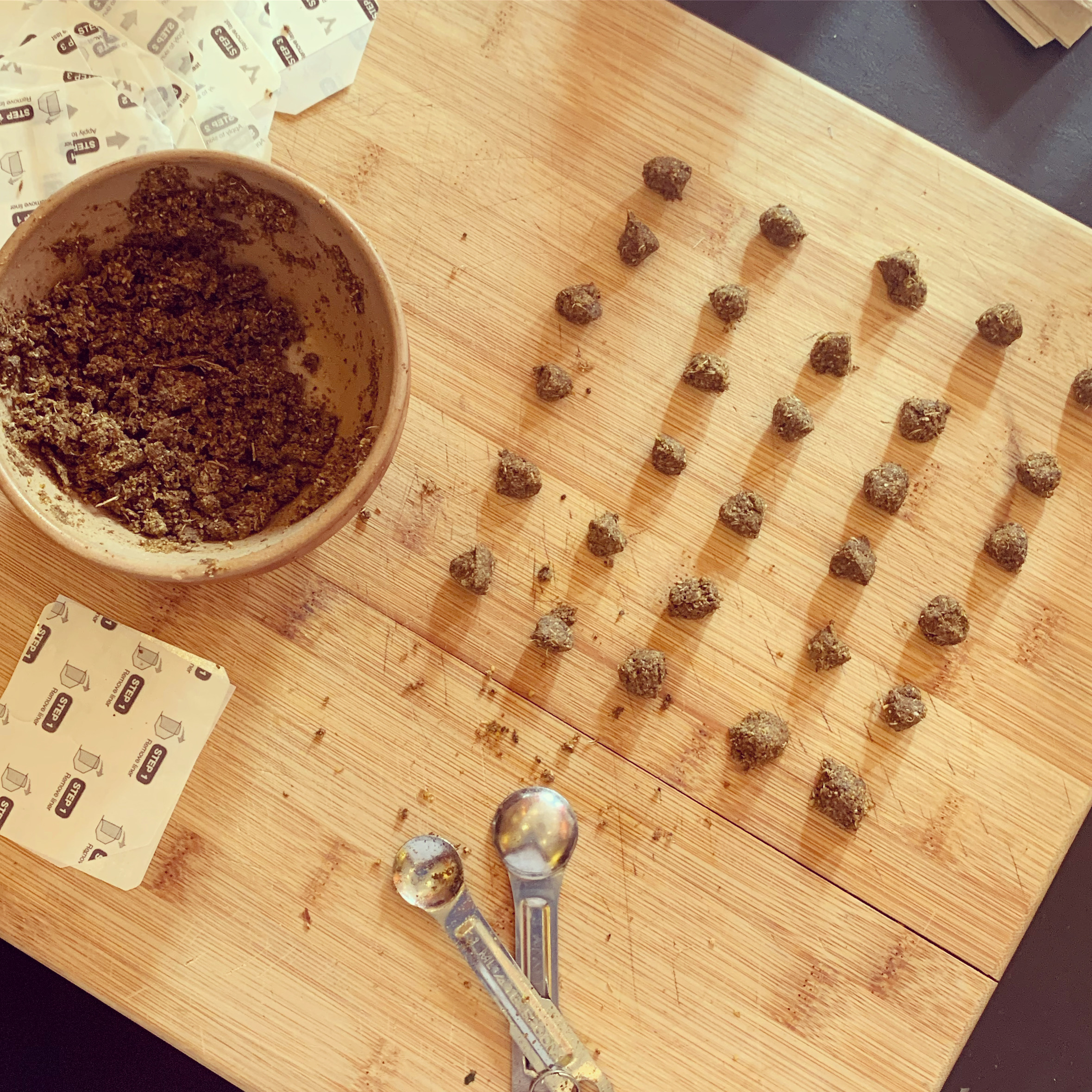
Each bag contains 25 grams of each herb, 150 grams total. The herbs are ground and sifted into a fine powder, ready to use once mixed with the moistening agent of your choice.
Moistening and forming the plasters: water or ginger juice are our usual choices — an easy shortcut is steeping a ginger tea bag until it’s cool enough to handle. Honey, sesame oil, and even petroleum jelly also work. Moisten the powder and form it into small balls (we measure ¼ teaspoon) for application. For asthmatic children, scale down to pea-sized and retain for only a couple of hours.
Securing the plasters: keep them in place with transparent Tegaderm bandages. Some practitioners tuck a piece of string or twine under the bandage, which makes removal easier when there’s no one around to help.
Point Selection by Treatment
First treatment: downbearing and diffusing the lungs: Dingchuan, BL-12, BL-13.
Second treatment: supporting the spleen and transforming phlegm: DU-14, BL-14, BL-20.
Final treatment: nourishing the kidneys to help them grasp lung qi: BL-11, BL-23, BL-43.
What to Expect
The herbs are applied and left on for several hours, sometimes up to a day. Itching and redness at the site are common, and blisters can form. If they do, instruct patients to apply a soothing burn cream at home; if they come into the office, Ching Wang Hung ointment works well applied directly.
How long the application stays comfortable varies widely — some patients feel caustic heat and itching within the hour, while others (we treated a yang-deficient patient last year who never felt any heat at all) barely notice it. As a general rule, we instruct patients to remove the plaster once it starts to feel irritating rather than holding to a fixed time.
The treatment can leave marks that fade over time. Let patients know this in advance, before treatment rather than after.
The treatment may leave marks that fade over time: Make your patient aware of this in advance.
Time is running out to purchase San Fu in time for the 2026 season, so don’t delay!